




Abridge Makes Context-Aware Clinical Intelligence Available to Every Clinician at Partner Health Systems
More than 300 enterprise health systems that represent over 250 million patients have adopted Abridge’s context-aware clinical decision support since launch in April.
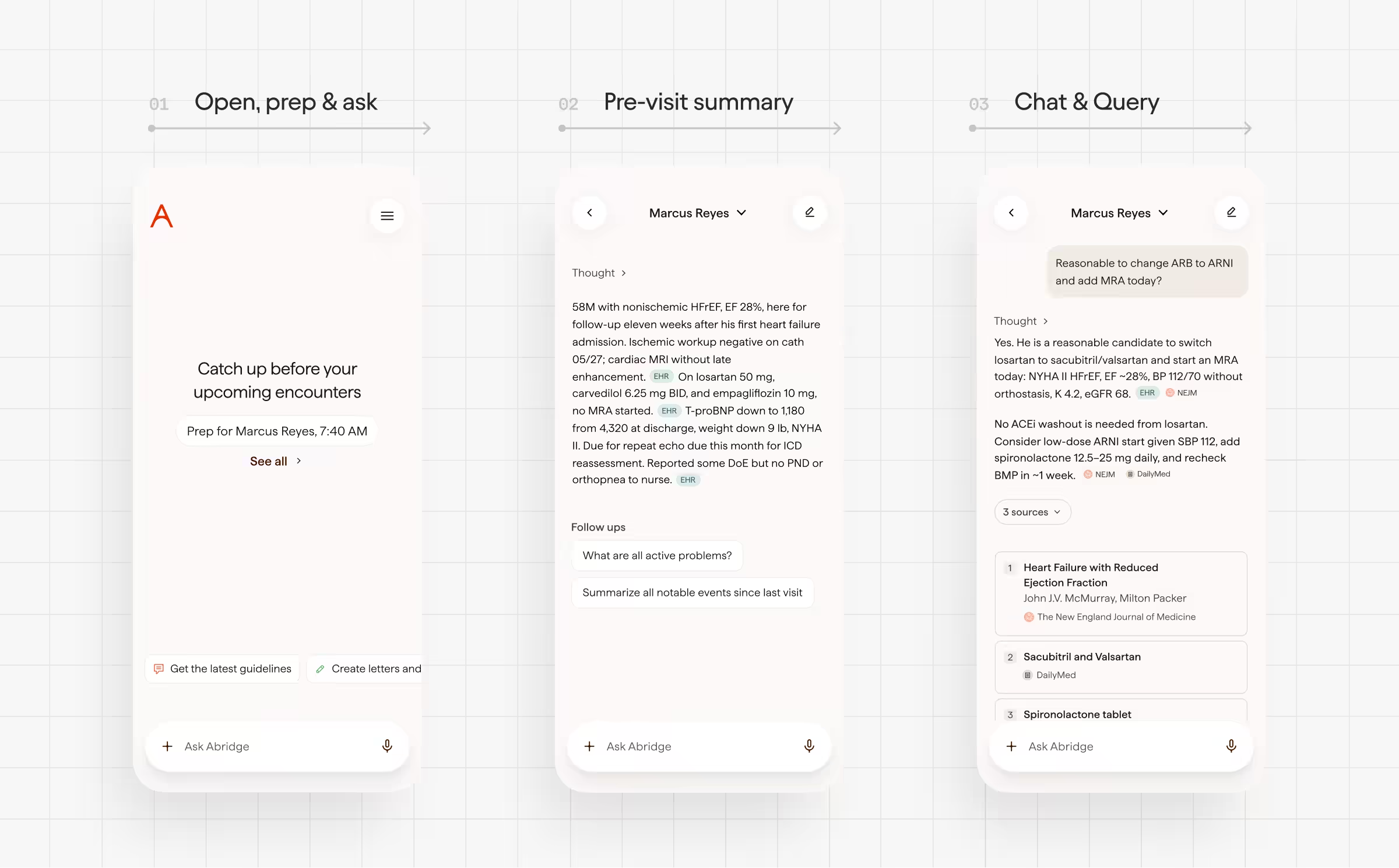
SAN FRANCISCO, CA (August 17, 2026)—Today, Abridge announced that partner health systems can extend its clinical intelligence agent to every clinician across their organizations, regardless of how that clinician documents visits today. Health systems can make the agent available through the EHR workflow clinicians already use, or on a new mobile and web experience, each connected to the patient's chart as part of a single organizational decision rather than a clinician-by-clinician rollout.
“Adoption of decision support has outpaced anything we've shipped before because it feels like a natural extension of Abridge. It understands the context of the patient in front of the clinician, it's grounded in the evidence they already trust, and it connects to what they want to do next," said Dr. Shiv Rao, CEO and Co-Founder of Abridge, and a practicing cardiologist.

Clinicians across more than 300 enterprise health systems have adopted Abridge's decision support capabilities since launch in April. Monthly active users have grown to more than half of eligible Abridge clinicians, and queries per clinician have tripled in the last two months.
“Our Abridge deployment is enterprise-wide, so every clinician at UPMC has access to the clinical intelligence agent," said Dr. Rob Bart, CMIO, UPMC Health Services Division. "More than 60% of our Abridge users have adopted it largely through self-discovery, with no additional training or campaign behind it. This only happens when the tool is embedded in the workflow, not adjacent, requiring extra steps to invoke or use. The more clinicians use it, the more it reinforces itself."
“The value of Abridge's clinical decision support is that it shows up at the exact moment a clinician needs it, with context that is specific to the patient in front of them,” said Dr. Eric Poon, Chief Health Information Officer at Duke Health. “We've seen it help clinicians manage cases as different as a rare neurologic presentation and an unusual facial rash by recognizing the clinical context, surfacing relevant guidance in real time, and supporting the next best action. The clinician never has to step away from the patient to go find it.”
Available to Every Clinician, Backed by the Health System
Clinicians increasingly reach for AI support at the point of care. Much of that adoption happens from the bottom up: one clinician at a time, on tools the organization did not select, with patient information traveling alongside the question.
Abridge’s clinical intelligence agent runs instead on the enterprise relationship partners already have with Abridge: the same security review, data governance, and EHR integration that support documentation today, rigorously evaluated and trusted by many of the country's leading health systems. Because access is provisioned by the organization rather than claimed by the individual, the agent can be securely connected to the longitudinal patient record. For health systems, extending it is a change to an approved deployment rather than a new solution to evaluate, integrate, and support.
"Our behavioral health clinicians handle some of the most sensitive information in the organization, and they were the most cautious about AI tools for exactly that reason,” said Dr. Amanda Bohleber, Chief Health Informatics Officer at Deaconess Health System. “What we've seen is that when the evidence is already inside the chart they're working in, they stop weighing whether the question is safe to ask—they just ask it. That's a meaningful change in how a specialty engages with clinical evidence."
"This didn't feel like a new tool to roll out. It showed up inside a platform our clinicians already trusted, so adoption was nearly instant. And because the guidance is grounded in the actual patient chart rather than a generic lookup, it's the right response at the right moment, not just a suggestion," said Dr. Danny Lee, Chief Medical Informatics Officer, Johns Hopkins Community Physicians.
For a clinician who uses Abridge to document, the agent is already part of the workflow. For every other clinician at the organization, it arrives as a new companion experience on mobile and web, connected to the same chart and the same evidence base. In both cases, the response is shaped by the clinical context of the patient in front of them.

The new experience will:
- Accelerate clinical workflows before care with pre-visit summaries that deliver a succinct, digestible paragraph, orienting the clinician to who the patient is and what's changed since the last visit, and medical calculators pre-filled with EHR data in workflow rather than in a separate application or browser tab.
- Enable more informed decisions during care or anytime, where clinicians have validated medical literature at hand (including content from The New England Journal of Medicine, the JAMA Network, the American Diabetes Association, the American Academy of Family Physicians, Neurology, the Journal of Clinical Oncology, and more—if health systems are already customers of UpToDate, Abridge can leverage that knowledge repository as well). Responses are shaped by the patient's chart, surfacing only what's most relevant. Clinicians can query the chart directly in the same chat window, with or without an active encounter.
- Work at the clinician’s direction after care, generating contextualized clinical artifacts like referral letters and clinician-to-clinician handoffs, all drawn from the patient's record.
- Advance each clinician’s medical practice by allowing them to claim AMA PRA Category 1 Credit™ for the clinical lines of inquiry they’re already pursuing for patients.
“Because Abridge is already embedded in the clinical conversation, it has the necessary context to provide highly personalized recommendations supported by specific references. It can also suggest additional questions that may be useful for the clinician to ask that help clarify the problem or refine the treatment recommendations. By integrating it into the EHR workflow and making it available to all clinicians with EHR access, this feature adds to the ever-growing AI-enabled decision support harness we are building for our clinicians to restore joy in medicine and achieve better, cost-effective patient outcomes,” said Dr. Lee Schwamm, Sr. Vice President and Chief Digital Health Officer, Yale New Haven Health.

At its Keynote in June, Abridge unveiled the first AI-native clinician intelligence platform, designed to help health systems coordinate the clinical, financial, and evidence-based decisions that shape every moment of care. Just last week, Abridge announced its agentic experience to support capturing the full complexity of patient visits with Care Signals. This launch is another example of Abridge building alongside health system partners to create agentic workflows that serve the needs of clinicians every day.

About Abridge
Founded in 2018, Abridge is the first AI-native clinician intelligence platform organized around the patient, built for clinicians, and designed to help health systems coordinate the clinical, financial, and evidence-based decisions for every moment of care. Powered by purpose-built AI for healthcare, Abridge connects patients, providers, payers, and life sciences companies. This year, the platform will support more than 100 million patient-clinician conversations across more than 300 of the largest and most complex health systems in the U.S. With deep workflow integration, the Abridge clinician intelligence platform has been validated to support encounters in 28+ languages across specialties and care settings.
Abridge is setting the industry standard for the responsible deployment of Al across health systems with continual and transparent Al evaluation. Clinical decision support references and cites gold-standard sources of evidence, and features like Linked Evidence map AI-generated documentation to source data, helping clinicians quickly trust and verify the output.
Abridge was awarded Best in KLAS for Ambient AI in 2025 and 2026, in addition to other accolades, including TIME Best Inventions of 2024 and 2025, CNBC Disruptor 2025, and Fast Company’s Most Innovative Companies 2025.