Healthcare is human.
Co-founder and CEO of Abridge
At Abridge, we’ve always believed that the best healthcare technology should make healthcare feel more human.
But over the last several years, the work of healthcare has become harder to hold in any one human’s head. There is more patient data to review, more plan information to reconcile, more medical literature to absorb, and more administrative context for any given clinician to carry.
When you’re in front of a patient and you’re already worrying about the note you owe, the claim you need to get ahead of, the calls you need to make for a prior auth…that’s not medicine.
Clinicians are stitching together workflows that span not just the patient but every part of the system: providers, payers, and life sciences companies. Whether they are always aware or not, clinicians play a part in every payer transaction, every research database, every registry, every claim.
More than four in ten clinicians reported to the AMA last year that they’re burning out1. More than a third said they’re considering leaving the profession2. It’s not because they stopped caring about patients, but because the overhead became overwhelming.
We’ve believed we could help fix the system by anchoring on the most human signal in all of healthcare—the conversation.
The conversation sits upstream of everything else: the note, the codes, the orders, the claim, the revenue cycle and the risk adjustment, and the clinical trial a patient might never hear about. If you can surface the right evidence at the right time in the right context, centered around the patient in front of you, you can change everything.
And it’s working.
We’ve partnered with more than 300 health systems, and will support more than 100 million clinician-patient conversations in the coming year. We’ve given clinicians time back, and now we want to bring the broader healthcare ecosystem into the picture, so clinicians can focus much more on the practice of medicine and much less on the process of medicine.
We don’t think the answer is to sprinkle AI over all of these workflows and existing business models, and hope things just get better. In fact, it could get a lot worse with PHI being shared in unapproved ways, or one AI bot working against another AI bot. Provider agents fighting Payer agents. That’s a race to a dystopian future nobody wants to live in.
We think our collective opportunity is to use AI to rethink and redesign the system.
In June, we announced the clinician intelligence platform. Anchored to the conversation, it connects providers to payers and life sciences, for every moment of care, informed by the latest clinical evidence.
We can compress workflows. We can shift them upstream. We can engineer context across multiple systems. We can move much of the work into the background, into the conversation, when the information is fresh, instead of weeks later.
Think about compressing a 12-step prior auth or claims process into a two-step process, or even an invisible process. We have an opportunity right now to make these workflows more real-time and more prospective.
The same is true for clinical trials. A clinician sees a patient who might be a perfect fit for a study that could change their care path. The clinician doesn’t know the trial exists because they don’t have the time to know. That match never gets made.
Imagine every clinician out there has a team of agents figuring out all the things they want to know, helping them ask the right question, leverage the right evidence, and create the most clinically useful and compliant note with all the right diagnosis codes.
Imagine if they felt like technology has their back.
No flashing lights, no beeping sounds—just intelligence working at every moment of care, across every care setting.
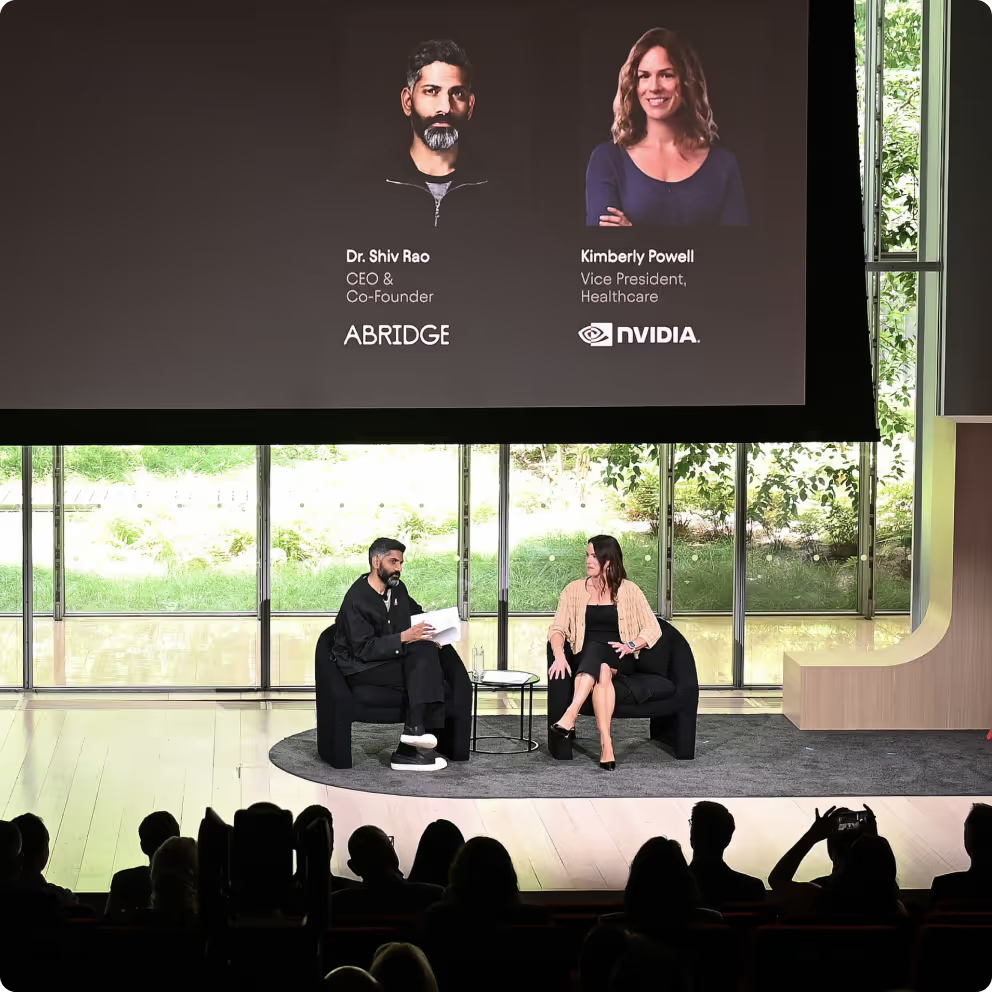
This is the time for transformation. There is tremendous collaboration in the industry right now. Companies across healthcare are working together in a positive-sum way to improve the care delivery experience. As we saw at Keynote, providers, payers, and life sciences organizations were all ready to share the stage with us in service of our common goals.
From electronic health records, to clinical trial management systems, to clearinghouses, to AI-native healthcare companies like Abridge, we are not competing. We are all leaning in.
I shared at our keynote that my dad was a cardiologist. He retired because he couldn’t type fast enough.
He’s 82 now, and he has heart failure. I commute from Pittsburgh to San Francisco every week so I can see him every Sunday. Those Sundays are sacred.
More than anything, I want to be able to say that we helped fix this. That we helped make the technology disappear, so nothing stood between a doctor and the patient in front of them.
It’s going to take all of us. And this is the moment.
Abridge unveils patient-centered clinician intelligence platform