








Now in Practice: October 2026
Welcome back to Now in Practice. This month, Visit Topics, In-Visit Orders, and Patient Visit Summary Editing with the Abridge Assistant help transform how clinicians prepare for a visit, capture orders throughout the conversation, and send patients home with a summary more easily tailored to them. Inpatient H&P and progress notes now draw on longitudinal chart data alongside the recorded conversation. The Query Engine now covers outpatient visits, and inpatient diagnoses accepted at note signature are written directly to the chart, improving coordination between clinical and revenue cycle teams.
For the leaders who govern clinical AI at their health systems, our new Evaluation Dashboard shows how we evaluate our clinical AI and the results that matter most to them.
Much of the work that makes a visit or a hospital stay take longer than it should is reconstruction: keeping track of which conditions still need follow-up, entering orders after the patient has left, assembling an admission note from across the chart. The clinical and CDI updates in this release each move a piece of that work upstream, while the context that matters is still fresh.
Saving clinicians time in clinic and across inpatient admissions.
Clinicians should be able to finish a patient conversation with less on their list than what they walked in with, and start an inpatient note from the context the chart already holds. Each capability in this section runs where clinicians already work, across their existing EHR workflows and Abridge.
Visit Topics
Visit Topics gives primary care clinicians a single view into the chronic conditions they plan to address in a visit alongside other relevant items. For patients with Medicare Advantage plans, Abridge identifies chronic conditions that were documented in a prior year but not yet for the current year. Before recording starts, clinicians can add or remove conditions while pre-charting. During the conversation, Visit Topics marks each condition as discussed when it’s addressed.
In-Visit Orders
As outpatient clinicians talk through orders with their patient, Abridge now surfaces each one in the Heard in Visit Recording module in Epic. New orders are added as they’re discussed, changed orders update in place, and retracted orders are marked, so the list always reflects where the conversation goes. The full set is staged in Epic for clinicians to review and sign, so they leave the room without a list of orders to enter between patients or at the end of clinic.
Editing Patient Visit Summaries with the Abridge Assistant
Clinicians can now use the Abridge Assistant to tailor the patient visit summary for whoever is reading it: adjusting the reading level, replacing clinical terms with plain language, addressing it to a parent or guardian, and changing the tone and length. Changes apply to the patient-facing summary only, not the clinical note. Patients are more likely to follow a plan they understand, and the visit summary is often what they take home.
Chart-Informed Inpatient H&P Documentation
Inpatient H&Ps now start from a review-ready draft, combining the recorded admission conversation with relevant chart data and placing it in the note for the clinician to edit and sign. Because it’s the first note of an inpatient stay, conditions present on admission are drafted from the start. Clinicians spend less of one of the busiest points of an admission searching the chart section by section, and the stay begins with a more complete, accurate record.
Progress Notes that Reference Chart Data
For inpatient progress notes, Abridge now generates the Assessment & Plan from the recorded conversation alongside what has changed in the chart since the last note: new labs, vital-sign trends, radiology findings, and more. Each chart-driven item appears inline in the A&P and is cited to its source. Clinicians can also build forward from a prior progress note, review, edit, and sign as usual. The result is an evolving A&P that reflects the patient’s current condition, so the care team works from the same picture each day.
Meeting CDI and revenue cycle needs without changing how clinicians work
A documentation gap that gets closed in the note is one that doesn’t come back to the clinician weeks later as a retrospective query, after the details of a patient encounter have faded. The capabilities in this section help more of the record arrive complete before it reaches coding, and they run inside the note clinicians already complete, with no need for a separate inbox or worklist. They build on Abridge’s Query Engine, which began surfacing AHIMA-compliant CDI queries in inpatient notes in July and added inpatient cues in September. This month, Query Engine extends to outpatient visits, and inpatient diagnoses captured from the conversation can be written directly to the chart.
Query Engine: Outpatient Queries
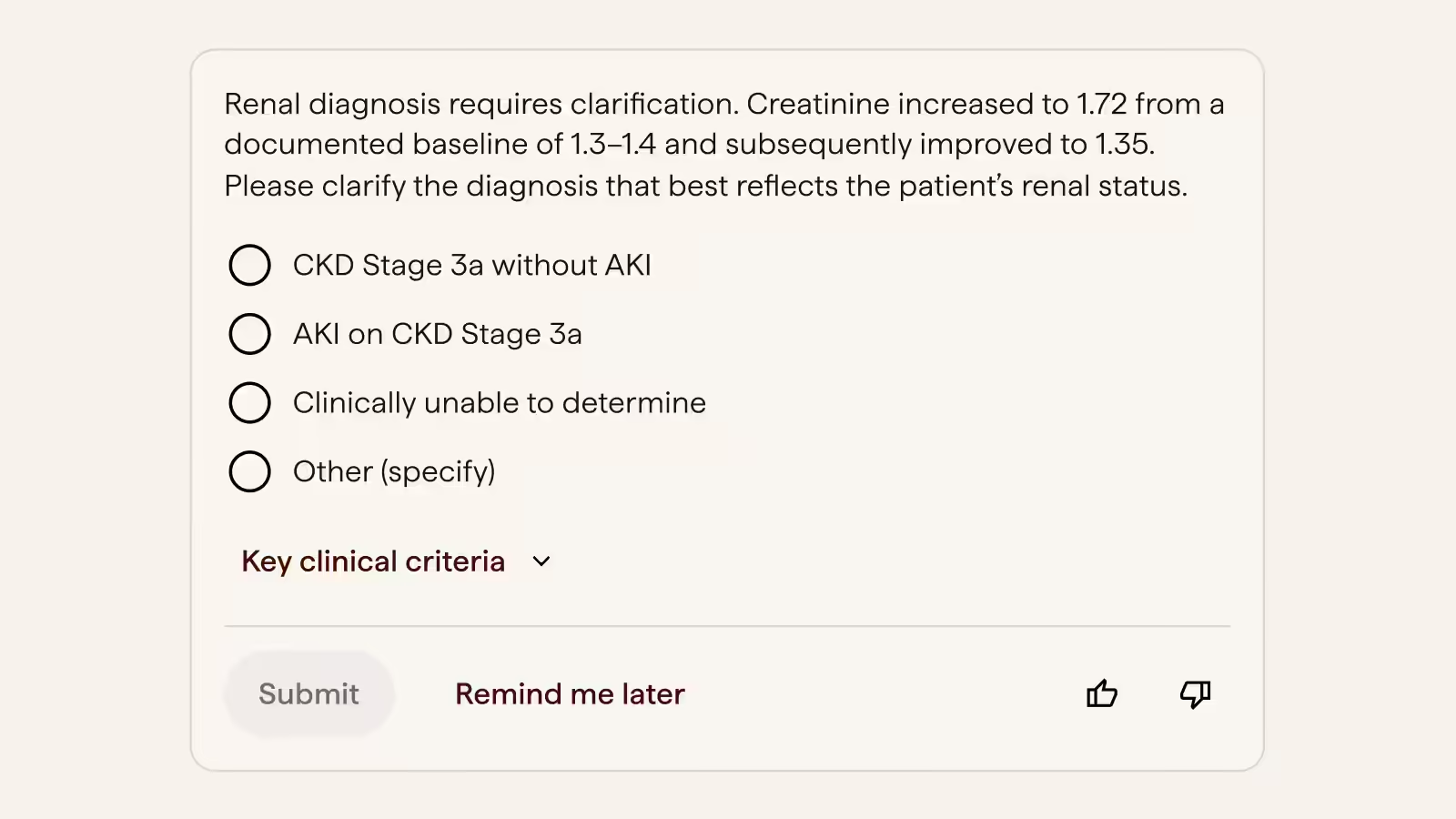
Outpatient clinicians can now resolve documentation queries inside the note while the visit is still fresh. When the documentation lacks the specificity a diagnosis requires, such as HFrEF without an ejection fraction or chronic kidney disease without a stage, Abridge surfaces a query inline with the clinical evidence behind it and response options to choose from. Queries follow AHIMA/ACDIS compliance standards, apply AAPC outpatient coding guidelines, and never suggest suspected or probable diagnoses. Resolving a query updates the note, and skipping it doesn’t block signature. Health systems get outpatient CDI coverage without standing up a new query team, and the specificity of chronic conditions is captured where the care was delivered.
Query Engine: Outpatient Cues
Not every documentation gap requires a formal query. Across outpatient encounters, the Abridge Query Engine now matches each identified gap to the right response: a formal, evidence-backed query where the detail calls for it, or a lighter, non-blocking cue where a quick prompt is enough. Clinicians act on or dismiss each one in the note, with no separate inbox to work later. Because the lighter response fits into the note itself, documentation improves across the whole clinician base, not only among the few clinicians who work a query queue.
Inpatient Diagnosis Write-Back
When a clinician finishes an inpatient note, Abridge now surfaces diagnosis suggestions drawn from the encounter directly, each carrying its specificity and present-on-admission status. Clinicians accept the ones that fit with one click, and accepted diagnoses are written directly into the inpatient chart with no manual re-entry. Documentation reaches coding and CDI more complete, so fewer queries return to clinicians days or weeks after discharge, and DRGs better reflect the complexity of care delivered.
Transparency into how we evaluate our clinical AI
Clinical AI is advancing quickly, and in healthcare, adding new capabilities alone doesn’t earn trust. These systems operate inside clinical care, and the health systems that govern them need to see how they’re evaluated.
Evaluation Dashboard
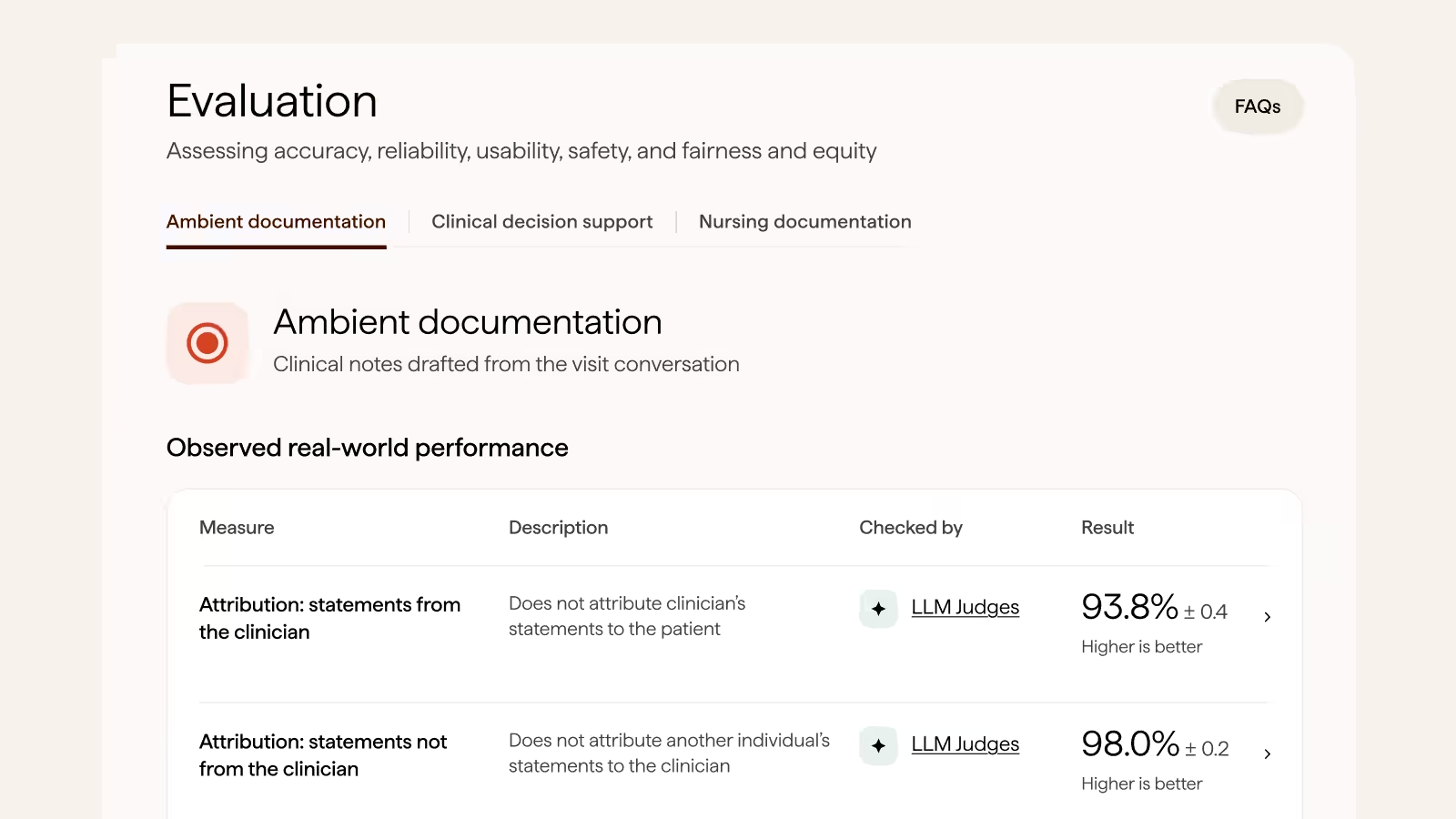
AI governance and clinical informatics leaders at partner health systems can now review Abridge’s clinical AI evaluation results directly in the Enterprise Portal. The Evaluation Dashboard organizes results by product and quality dimension, and each measure carries a plain-language description, its methodology, how often it’s refreshed, and its known limitations. Recurring monthly metrics are shown separately from fixed, peer-reviewed studies, with links to the full model cards. Results reflect performance measured across Abridge’s products broadly rather than a single health system’s data. Instead of piecing together model cards, studies, and one-off explanations, governance teams have one current reference to support their own oversight and safety review.
Why every number shows its method. A single performance figure says little on its own. What matters is what was measured, how, how recently, and what the measurement can’t tell you. Our evaluation pairs automated measurement with clinician judgment, validates models before release, deploys them in stages, and keeps monitoring performance once a capability is in use, because evaluation doesn’t stop at launch. Showing methodology and limitations next to each result lets governance teams check the work themselves, and it raises the questions worth asking of any clinical AI vendor: how is it evaluated, by whom, how often, and with what limits.
For a closer look at how our teams build, measure, and ship clinical AI, visit our technical blog at tech.abridge.com.
This month’s release moves more of the work around care into the encounter itself. Conditions due for follow-up are in view before the visit starts, orders are staged before the patient leaves, and inpatient notes start from what the chart already holds. Documentation gaps close in the note rather than in a query weeks later, and the evidence behind Abridge’s clinical AI is open for partners to review. We’d love to have you see it in practice.