



Now in Practice: August 2026
Welcome back to Now in Practice. The throughline in this month’s release is the context that Abridge already has, and how it can directly impact clinical workflows. Summaries that arrive before the visit, the admission, and the round, so clinicians start their day informed instead of catching up. And context that carries forward the work that clinicians have already done, transforming clinical inquiries through Abridge AI into CME credits that are earned without setting a weekend aside. So much of the clinical work done each day sits outside of the note, and each is a version of the same goal: putting what Abridge has already captured to work, so there’s less for clinicians to reconstruct and less to go looking for.
Support for every moment of care
Four capabilities in this release take on the smaller points of frictions that fill an average clinical day: the question that’s faster asked than typed, the calculation that shouldn’t require leaving the room, and the credit that shouldn’t require a clinician’s weekend to recognize.
CME Credits
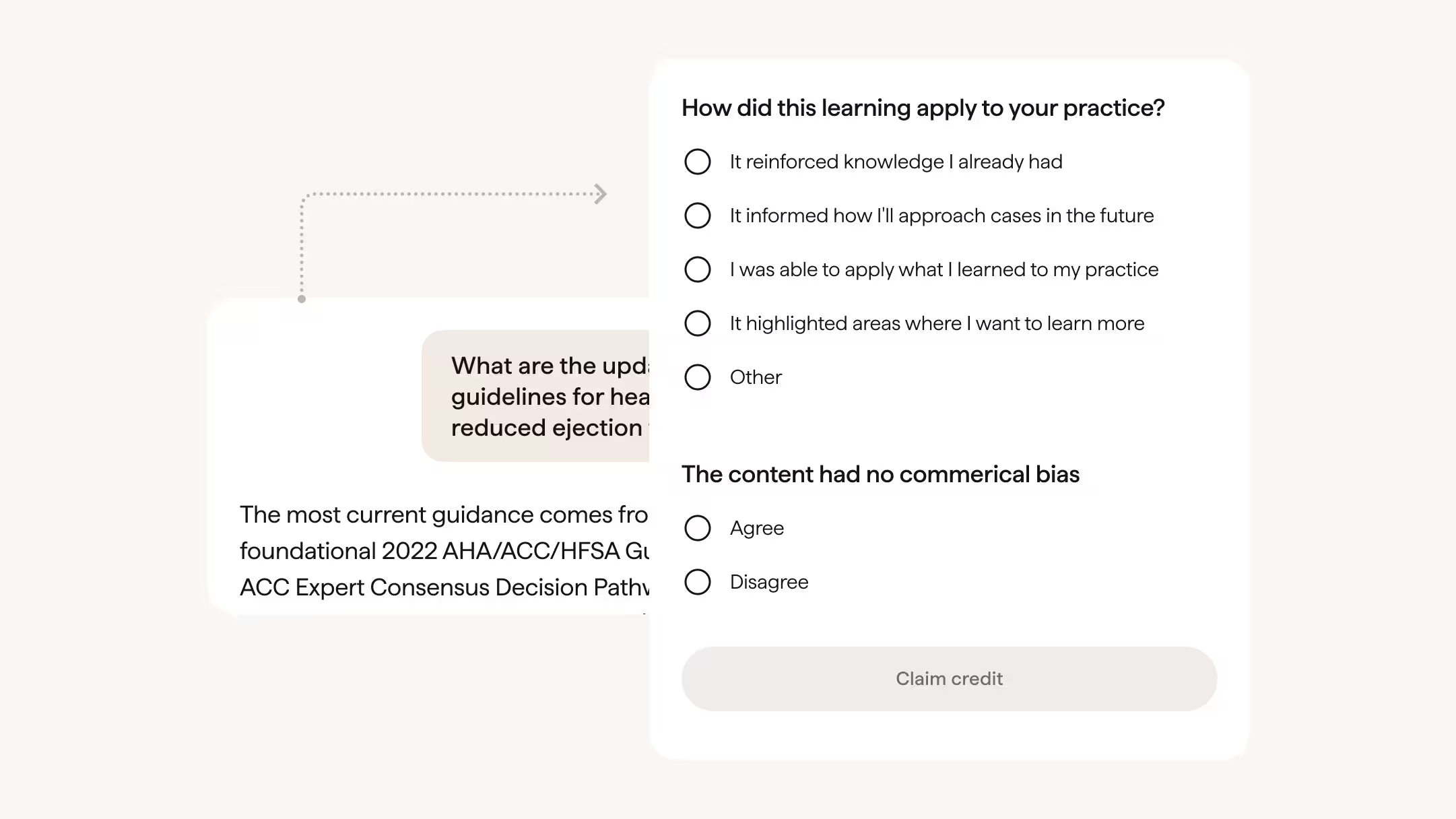
Since Abridge AI launched in April, clinicians have asked for the learning it enables to count for something. Now it can: review an eligible topic tied to a de-identified question already asked, complete a short attestation, and claim AMA PRA Category 1™ credit toward licensure and board requirements. The learning is already happening at the point of care, and this is what helps recognize it.
Medical Calculator Support
Medical calculators now open in Abridge AI with their inputs populated from the context Abridge already has: what was discussed in the conversation, prior notes, labs, and vitals. Clinicians confirm the values and run the score without breaking away from the patient to hunt down each one. The point isn’t a faster calculation, it’s keeping a decision inside the moment when it can still change what happens next.
Speak to Abridge AI
A tap of the mic lets clinicians ask Abridge AI a question out loud instead of typing it. The question is transcribed into the conversation and answered in place, so it works on a phone, between patients, or anywhere a keyboard is out of reach, or inconvenient to use.
Voiceprints
Clinicians can now record a Voiceprint once, and Abridge will tune its speech recognition to how they actually speak: accent, cadence, and the terms they reach for most. Dictated notes and ambient conversations come back with fewer misheard terms, and in a room with several speakers, their words stay more closely attributed to them. One enrollment, applied across both dictation and ambient workflows from the next conversation onward.
Less friction across outpatient visits
Preparing for a visit and coding it both tend to happen outside the visit, during time that could be better spent elsewhere. Two updates this month highlight how Abridge is supporting clinicians before, during, and after every patient visit.
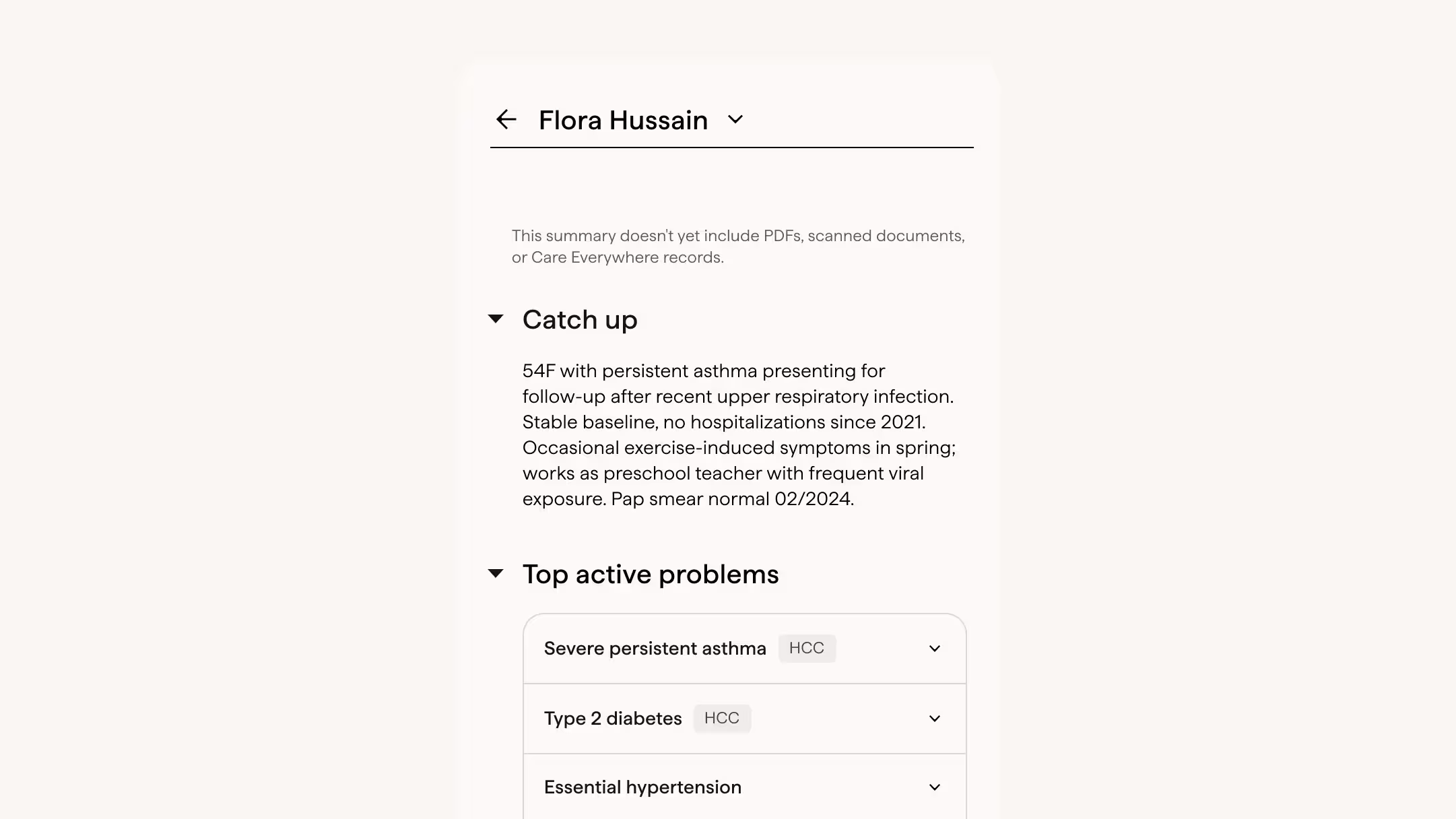
Pre-Visit Summaries
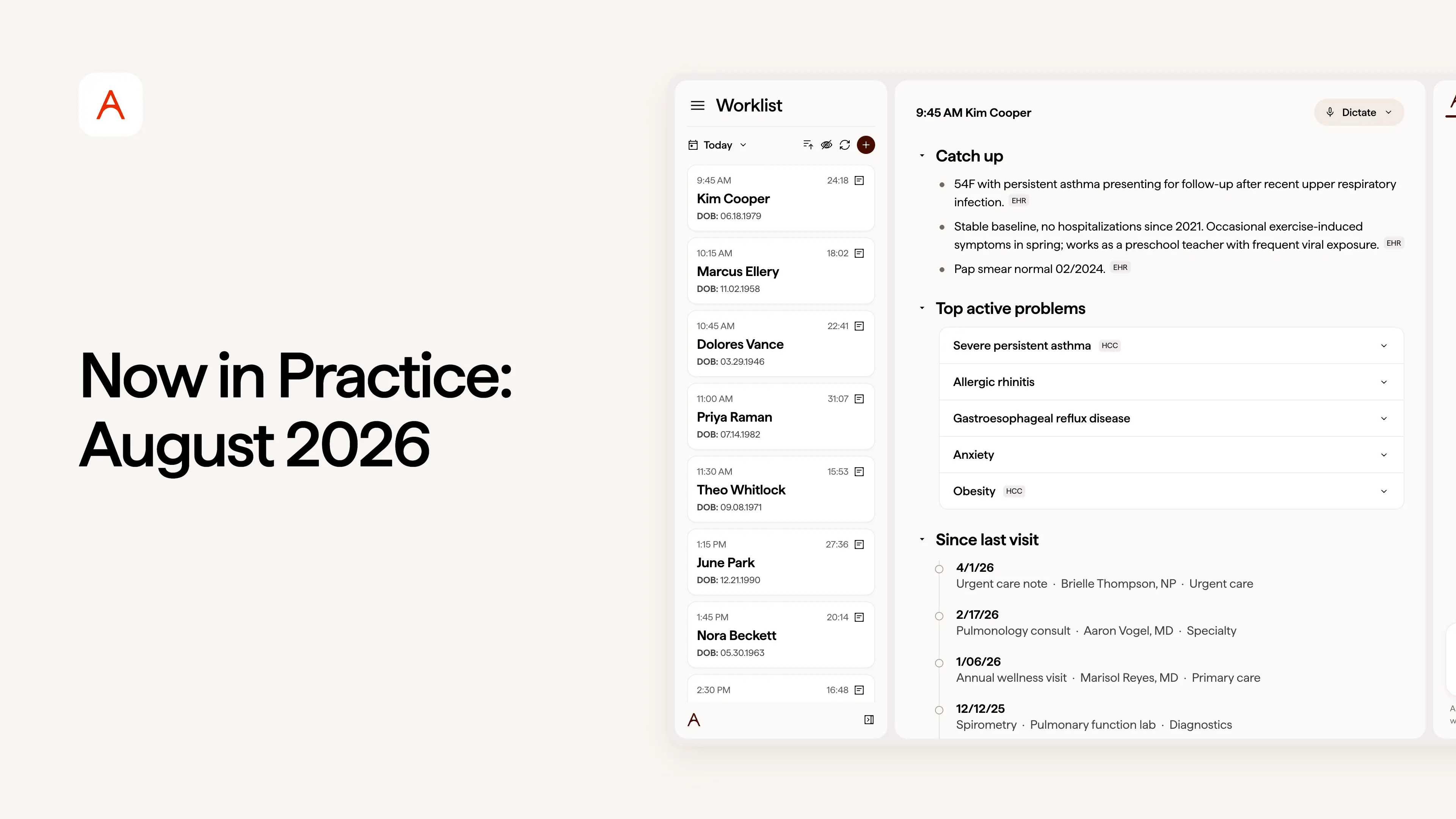
Pre-Visit Summaries open with a concise overview of the next patient’s history, active problems, and what’s changed since the last visit, with a chronological rundown of prior encounters underneath. Every detail links back to its source in the chart, so anything worth verifying is a click away rather than a chart search. The goal is a clinician who walks in already oriented, instead of one choosing between reading the chart and running on time.
Inline Level of Service
The CPT code and the evidence behind it now sit directly below the Assessment & Plan: which elements of medical decision-making were weighed, how time-based criteria compared, and what in the documentation supports each. Clinicians can adjust an input and recalculate between time- or MDM-based models without ever leaving their documentation workflow.
Why it shows its work. Returning a code is the easy part. Building a feature that shows the why behind each calculation is what builds trust with clinicians and CDI teams alike. A level-of-service recommendation that arrives as a bare number asks a clinician to trust an outcome they can’t inspect, and coding is exactly the place where an unexamined suggestion can become an audit conversation months later.
Richer chart context for inpatient care
Inpatient care is a moving target: a patient’s story changes across shifts, services, and handoffs, and the team caring for them changes with it. Two additions in this release help to surface what matters most at the two points where that context is hardest to rebuild, at the start of an admission and again the morning before rounds. Every member of the care team works from the same picture, with the details they need to make the right call at each point in an evolving inpatient stay.
This builds on Abridge’s Query Engine, included in last month’s release, which detects missing or under-specified diagnoses during the inpatient stay and surfaces AHIMA-compliant CDI queries inline in the note. Clinicians can then resolve documentation gaps at the point of care rather than weeks later in retrospective review. Together with richer chart context before admission and rounds, it’s part of a broader shift toward bringing clinician intelligence into the moments when clinicians can act on it.
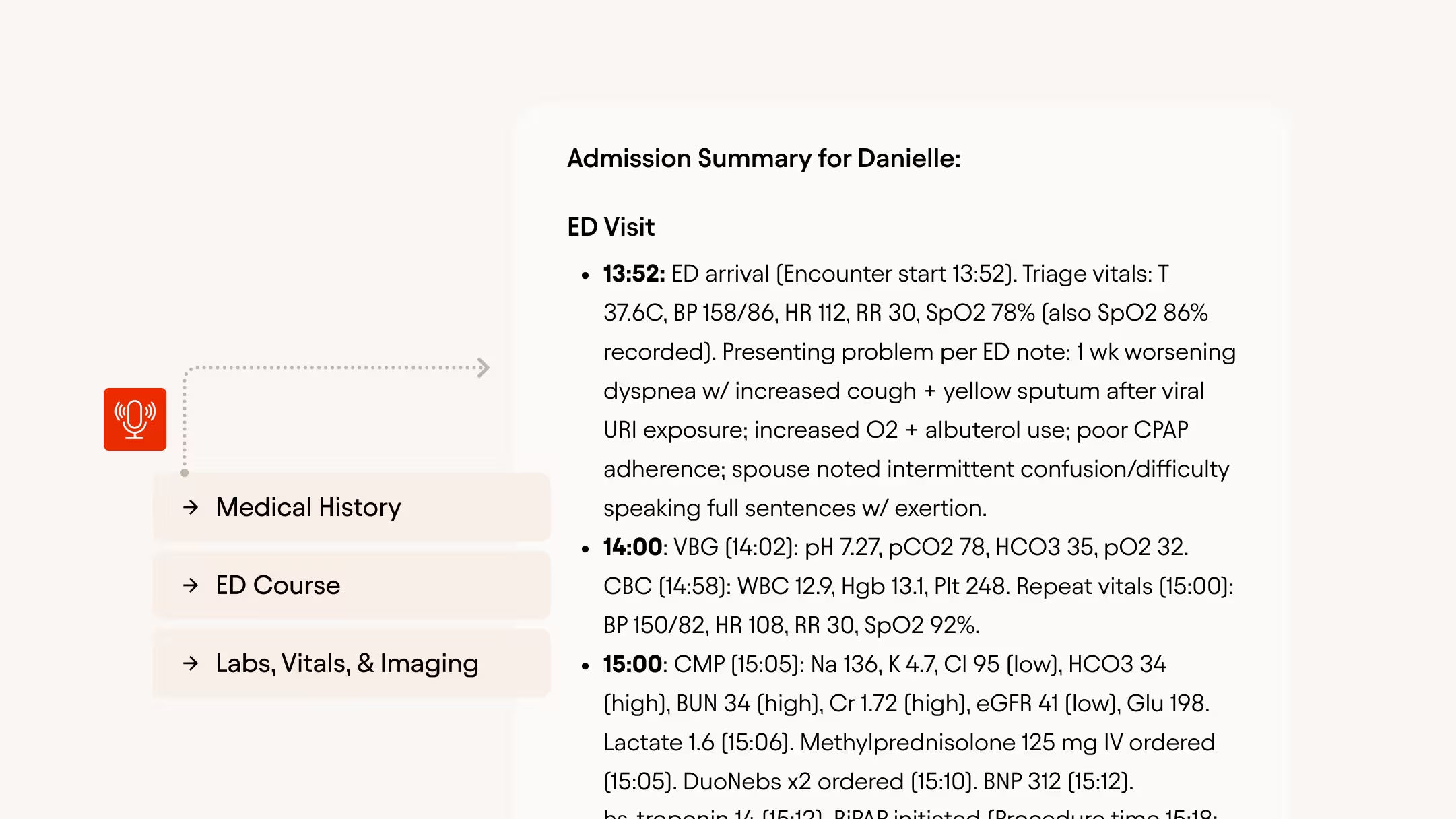
Pre-Admission Summaries
Pre-Admission Summaries synthesize the ED course, current labs, vitals, imaging, and relevant prior documentation into a single view at the start of an admission. Clinicians can catch up on the story so far rather than assembling it in pieces between pages. The first hours of an admission can set the trajectory for everything after them, and they shouldn’t turn on how much time there was to dig.
Pre-Round Summaries
Pre-Round Summaries consolidate each patient’s last 24 hours—signed notes, vitals, labs, imaging, and discharge-readiness signals—into one view before rounds. Clinicians arrive knowing what shifted overnight instead of reconstructing it chart by chart beforehand. Rounds are where the day’s decisions get made; the time leading up to them should go toward preparing, not catching up.
This month’s releases show what that next layer of value can look like. A clinician walks into a visit already oriented, asks a question without typing it, runs a score without leaving the room, closes the note with the coding evidence already attached, and earns credit for the questions they asked along the way. That’s what we shipped in August, and we’d love to have you see it in practice.