



How Clinician Demand Made Abridge Deaconess Health's Trusted AI Partner
At Deaconess Health System, leadership had set out to find an AI partner clinicians would actually want to use, and the proof showed up fast: clinicians getting real time back with patients, colleagues recommending it to peers unprompted, and locum clinicians choosing Deaconess over other opportunities specifically because Abridge came with the job. Every signal pointed the same direction, so leadership followed it. They removed the cap entirely.
Abridge License Expansion

This is that story, told by the people at Deaconess who watched the curve outpace every ceiling they set, and why they see it as proof of trust in an AI partner that keeps innovating and earning it.
Protecting the Sacred Moment
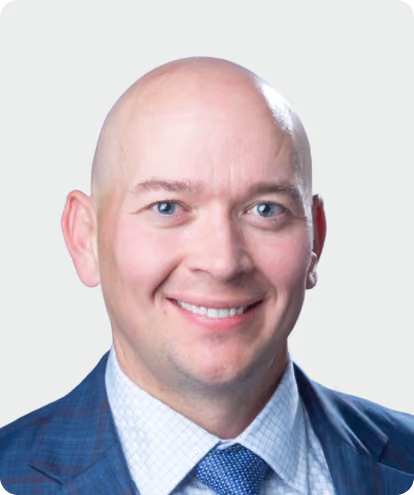
Jared Antczak, Chief Digital Transformation Officer: Early in my career, I witnessed a paradox of modern healthcare: technology designed to improve care often pulled caregivers away from the very people they were trying to help. The computer in the exam room was an essential tool for delivering care, but too often it pulled attention away from the “sacred moment” between a patient and their physician. I believed there had to be a better way.
Over the years, our industry has made meaningful progress in reducing administrative burden and giving clinicians more time to focus on care. However, the introduction of ambient documentation has been truly transformational. For the first time, technology is receding into the background and supporting the conversation instead of competing with it.
Rather than asking people to work for technology, we are finally making technology work for people. We are giving clinicians something incredibly valuable: the ability to be fully present with their patients during the moments that matter most.
Outgrowing Every License Tier

Kimberly Mason, Innovation and Digital Transformation: Abridge represents the kind of innovation we want to bring forward at Deaconess, technology that solves a real problem, earns clinician trust, and scales because people see the value in their everyday work. Abridge was one of the first initiatives to move through our formal innovation evaluation process, and it has become a strong example of why that process matters.
We started with a focused pilot around a clear clinician pain point, gathered feedback, measured adoption, and scaled when the value became evident. As demand grew from 200 licenses to 750 and continued beyond that, we recognized that this was no longer something we needed to push; clinicians were pulling it forward.
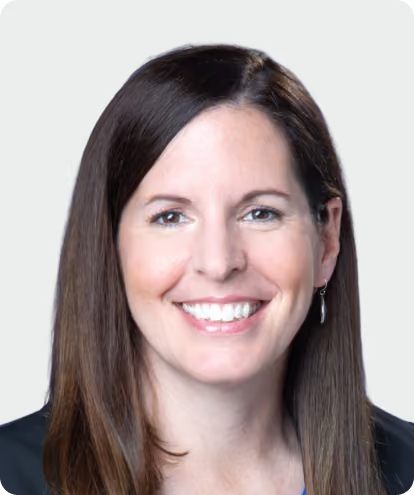
Dr. Amanda Bohleber, Chief Health Information Officer: I've been with Deaconess for 21 years as a practicing family physician, and I've been using Abridge since August of 2024. We leverage an AbridgeSignUp email group, and I’m seeing the requests pour in daily.
We don't have to advertise it anymore. Clinicians are recruiting their own peers to the platform by word of mouth.
The Feedback Loop That Turned Skeptics Into Advocates
Dr. Amanda Bohleber: What I'd point to first is that we are a preview partner for Abridge. We have a core group of clinicians who try take on new features early and give feedback, and when they see that feedback turn into a real product change, it becomes a flywheel. Because Abridge evolves so quickly, we had this pattern where clinicians who were initially hesitant would come back later to a completely different product, with ten or fifteen things changed and improved.
That's where our "late bloomers" have come on board. It's gone well beyond the note for a lot of our clinicians, and now nobody wants to miss what's coming next, because the roadmap is shared consistently with our medical group. It gives people something to look forward to. Especially for our inpatient clinicians, who have to stay laser-focused amid a lot of competing distractions and growing patient complexity, having technology that supports confident clinical decisions all together just makes for a better day.
Adoption Across Every Specialty
Dr. Amanda Bohleber: Clinicians across specialties are jumping in and finding value. If I had to point somewhere, primary care has probably always been the group carrying the heaviest documentation load, just given the volume and variety of what comes through in a day. But honestly it's been broadly helpful, not limited to one corner of the system.
Kimberly Mason: Family medicine is clearly a heavy adopter, and probably the highest-volume group overall, but it really is across the board. We have strong feedback we've collected over the last 18 months from clinicians in different service lines that speak to that.
Beyond Usage Numbers: A Recruiting and Retention Advantage
Dr. Amanda Bohleber: We've had locum clinicians choose Deaconess over other opportunities specifically because we could offer them Abridge. That's the kind of thing that tells you this isn't just a documentation solution anymore. It's become part of how we compete for talent.

Adam Fiedler, Chief Clinical Applications Officer: From an applications standpoint, the reason this kept scaling is that Abridge never stopped adapting to how our clinicians actually work. Every time we brought them feedback, we'd see it addressed quickly, not eventually. That kind of response is rare, and it's exactly why what started as a pilot kept growing past every number we set for it, all the way to unlimited.
Jared Antczak: A lot of what I spend my time on is technology that has to be pushed into a system: new acquisitions coming online, integrations that take real change management to land. Abridge has been the opposite of that. We didn't have to push it; we had to keep up with it.
When a platform spreads because clinicians are pulling it toward themselves, not because we've mandated it, that's the clearest signal I know of that it's actually solving a real problem. As we keep growing, bringing on new hospitals, new communities, new clinicians, that's exactly the kind of technology we want more of: the kind that earns its own adoption.
Next Up: Nursing Pilots and Broader Access
Kimberly Mason: We're moving into a nursing pilot now, which is a new frontier for us. We're also looking at extending access to non-Deaconess-employed clinicians, something we'd held off on while we were working within a fixed number of licenses. Now that we're in an unlimited model, everybody who gets hired and needs a license simply gets one; we don't have to manually scrutinize that anymore.
Dr. Amanda Bohleber: The requests keep coming in, and what's kept that trust intact is that Abridge keeps evolving fast enough to earn it. If someone tried it once and it wasn't quite right for their workflow, we tell them to come back and try it again, because there's a good chance something they were waiting for has already arrived.