




How Context-Aware Decision Support is Reshaping Clinical Practice: Olivia Taylor of Deaconess Health
Psychiatric care requires a high degree of personalization that balances clinical rigor with a respect for humanity. Clinicians need deep knowledge of medications, interactions, and treatment approaches while continually assessing what patients report and how their symptoms, behavior, and functioning change over time. Treatment decisions depend on bringing together the patient’s story and the latest evidence, with room for adjustment at any time.
Abridge's clinical intelligence provides evidence at the point of care, contextualized to the patient in the room. It leverages the patient conversation alongside information from the electronic health record—including prior notes, labs, diagnoses, and other chart data—to shape the evidence it surfaces during care. No switching tabs. No digging for labs. Just evidence-based insights, tailored to each patient's clinical situation, now implemented enterprise-wide at more than 300 health systems.
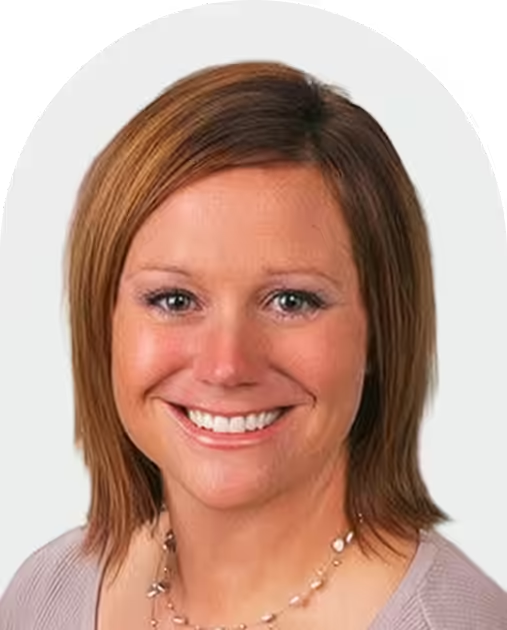
We sat down with Olivia Taylor, a psychiatric mental health nurse practitioner at Deaconess Health with a decade of experience across both inpatient and outpatient care. In our conversation, she shared how Abridge's clinical intelligence has changed her day-to-day workflow, a recent example of how she used it with a patient to support her recommendation on tapering a medication, and the relief she experienced after a day of helping people through “some of the hardest moments of their lives.”
In Conversation with Olivia Taylor
Tell us about your practice. What does a typical day look like?
I'm a psychiatric mental health nurse practitioner, and I've been doing this for about ten years. I worked inpatient here for seven years before making a change to outpatient, where I've been for the past three. Outpatient is my primary place of practice now, but I do still cover the inpatient unit when needed, so I use decision support in both settings, even though they're pretty different from each other.
Take us back to the first time you used clinical intelligence within Abridge. What was your initial reaction?
I knew immediately that this was going to save me a lot of time. As a clinician with a decade of experience, I know most of the information I need day-to-day, but I frequently want to verify the latest guideline recommendations, monitoring schedules, medication interactions, or taper strategies. Psychiatry is not a cookie-cutter approach. Every patient is different, and developing unique treatment plans takes time to create.
How would you describe the impact it's had on your workflow?
Before I had Abridge, checking something meant stopping the visit and pulling out reference sheets, tables, sticky notes, whatever I had, and then figuring out what was actually current. Now, I can ask the question in natural language without leaving the conversation, and what comes back is already shaped around the patient in front of me, not a generic answer I have to adapt myself. It's made me noticeably more efficient, without giving up the evidence-based care I pride myself in using. And it has sharpened my critical thinking. I'll ask a question and it often surfaces an angle maybe I hadn't considered, something to build on rather than simply accept.
Walk us through a recent example of how you used decision support with a patient.
I had a patient who wanted to try tapering off Pristiq. She'd tried before and had a hard time with it. It's a difficult medication to taper off for a lot of people, with symptoms like brain zaps and flu-like symptoms. During the visit, I asked Abridge about updated evidence-based taper strategies after a prior failed attempt, and it surfaced recommendations for a slower taper and using fluoxetine as an adjunct, which confirmed a strategy I was already familiar with. It didn't make the decision for me, but it helped guide the conversation with the patient and allowed us to talk through it together. She was able to go home and discuss it with her husband knowing we had a solid plan in place.
What has having decision support within Abridge changed for you about practicing medicine?
It's given me back so much mental bandwidth. Carrying every guideline, every monitoring parameter, every patient interaction in my head, on top of sitting with people through some of the hardest moments of their lives, takes a real toll over an eight-hour day. I wish I could adequately describe what it feels like walking out of work at the end of the day now compared to before. I used to have nothing left. That's no longer the case.
This interview was edited for length and clarity.
Want to hear from more clinicians like Olivia? Check out the rest of the series on our newsfeed here. And if you're curious how Abridge's context-aware decision support could fit into your workflow, head to the CDS page on our website to learn more.