




The Future of AI Pre-Charting Is More Than a Chart Summary
With Katie Brown, Pierre Zéboulon, and Rohan Wadhawan
Inside how we built pre-visit summaries to surface the right context from the patient record without overloading clinicians with information.
The patient record contains more information than any clinician needs at any one moment. AI has the capacity to read and process that information instantly, but generating succinct summaries that adequately prepare clinicians across care settings and specialties for each of their patients is a much more complex task.
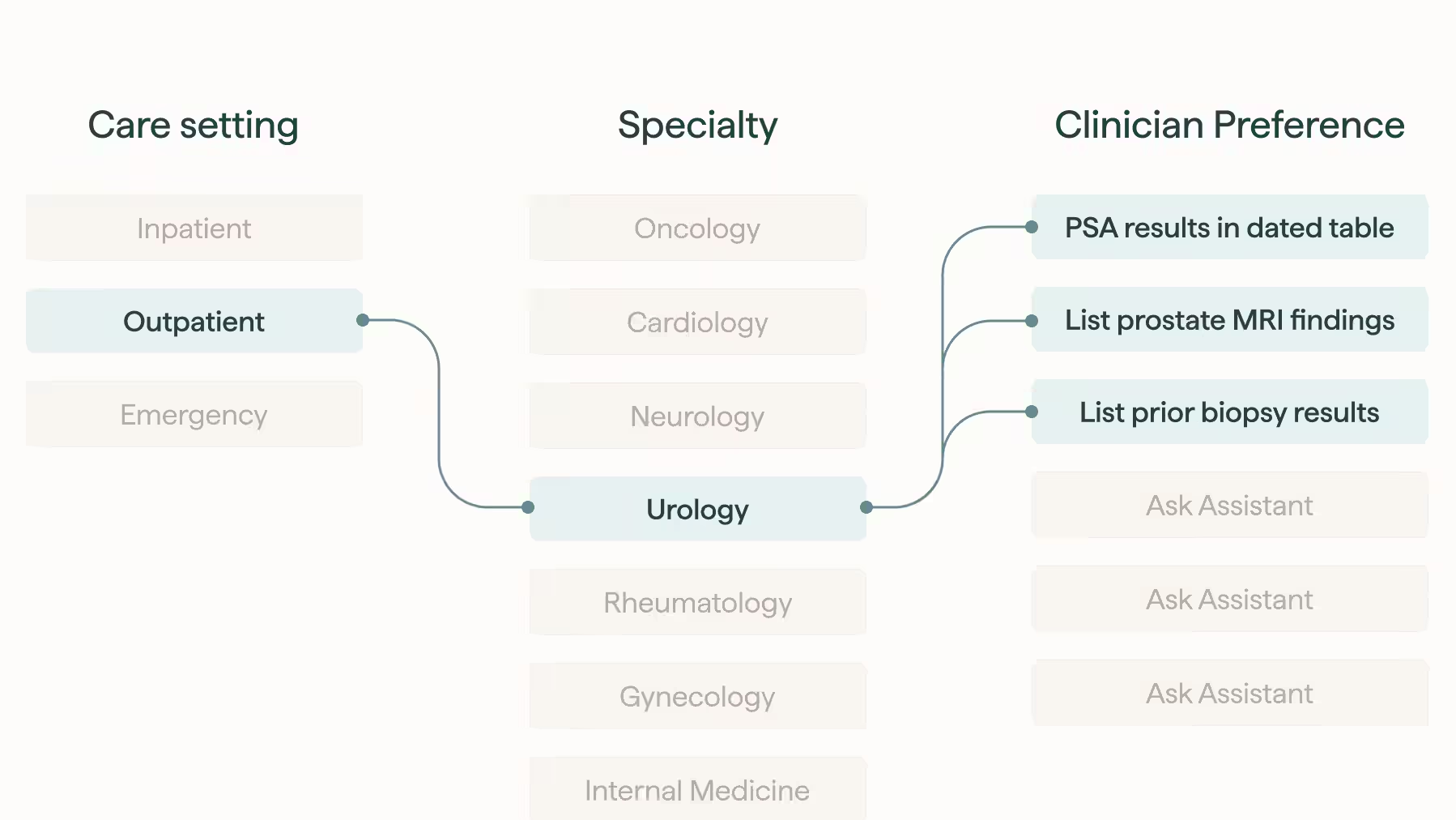
Now available across 300+ health systems, our pre-visit summaries were developed alongside clinicians at Abridge partners to ensure they deliver the appropriate context for every encounter, with relevance shaped by care setting, specialty, and clinician preferences.
The Right Context For Each Encounter
Clinicians often spend hours preparing for their upcoming visits or shifts: reviewing notes, labs, imaging, medications, and other parts of the patient record to understand what has changed and what is important to know before entering the room. Reading the chart takes time, but the most difficult aspect is identifying the most important information for the patient they’re about to see. Crucial details can be missed because they are buried or hard to find, especially when the patient record is long and complex.
“For pre-charting, I’m finding that a well-aimed telephoto lens is often the better tool,” wrote Dr. Stephon Proctor, the Associate Chief Health Information Officer at Children’s Hospital of Philadelphia, and a practicing pediatric psychologist, on LinkedIn about pre-visit summaries. A “wide-angle lens” might work for whole-chart summaries, but when preparing for a specific encounter, Dr. Proctor values “the right content.”
What Dr. Proctor values about the “telephoto lens” is how Abridge selects the right information and orders it appropriately:
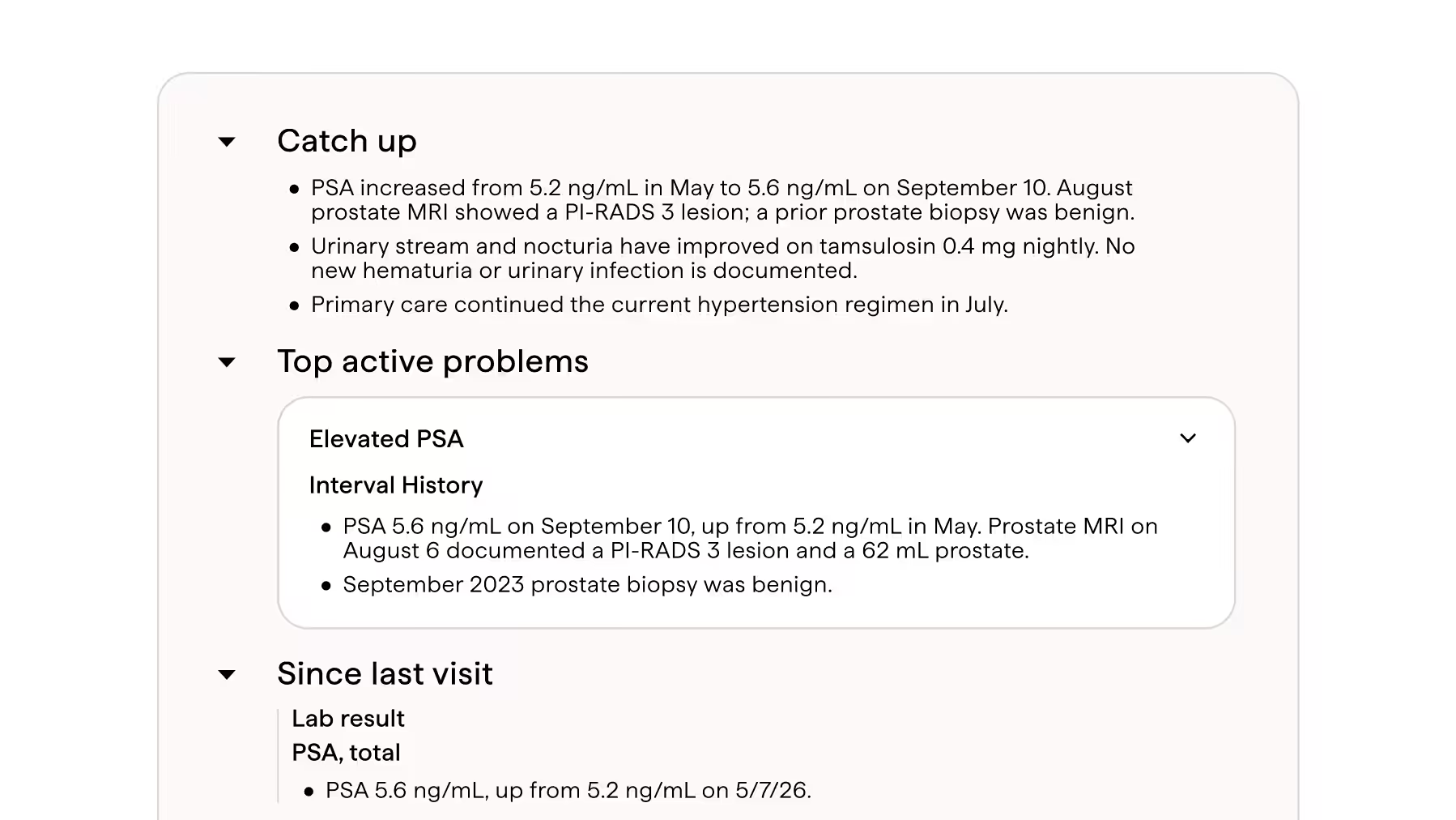
- Catch up: A short summary of the patient's recent care, tailored to specialty.
- Top active problems: The most recently and actively managed problems, tailored to specialty. Filtering out problems outside each clinician’s scope makes review more efficient.
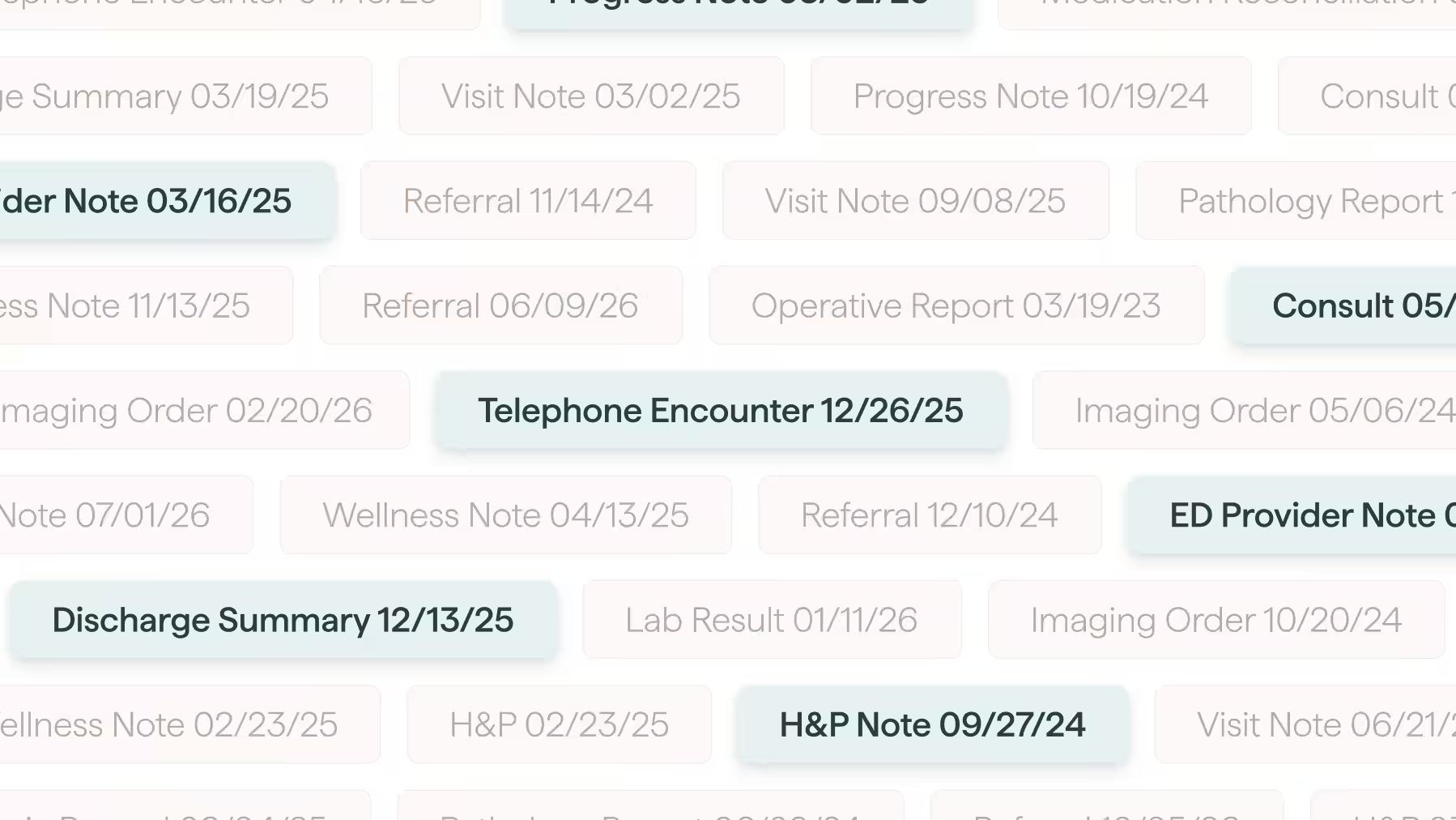
- Since last visit: Recent notes sorted by date, summarizing each visit's purpose, status, and any changes to care. This includes both face-to-face and telephone encounters.
Relevance Starts With the Moment of Care
What belongs in a useful summary depends first on care setting. A clinician admitting a patient to the hospital, an emergency physician seeing a new arrival, and an outpatient clinician preparing for a scheduled visit are looking at the same patient record through different lenses.
Outpatient: What happened since I last saw this patient?
For outpatient care, the challenge is time between visits. A clinician may be seeing a patient for the first time in six months, a year, or longer. In between, the patient may have seen other specialists, visited the emergency department, been hospitalized, changed medications, or undergone new testing and procedures. Answering this question can get complicated quickly. How far back should a summary look? What actually counts as the “last visit”? Which encounters matter enough to bring forward?
Inpatient: What changed overnight?
For inpatient care, the patient story evolves continually. Clinicians need to understand the current episode. What brought the patient in? What has happened since admission? What changed overnight? And what requires attention today? Abridge's pre-admission summary and pre-round summary for inpatient care serve hospitalists by providing each clinician with what they need to enter the room prepared.
Emergency: What matters for this patient right now?
In the emergency department, clinicians need to orient quickly around the current presentation. That means informing the reason for the visit with the history, recent encounters, medications, vitals, and results relevant to what is happening now. Abridge’s pre-visit summary for ED is currently available to preview partners, and is coming soon for all Abridge partners.
Different Specialties, Different Context
The same patient record can mean different things to different specialists. A cardiologist, oncologist, and dermatologist may reasonably focus on different problems, events, tests, and time horizons.
Abridge filters the EHR problem list so that the summary and problem-based sections are focused on relevant conditions for each specialist. For example, a problem list for a primary care clinician will be exhaustive and may include dozens of items, from “primary osteoarthritis of both knees” to “NICM (nonischemic cardiomyopathy),” “generalized anxiety disorder,” “morbid obesity,” and “essential hypertension.” But when that same patient sees a cardiologist, the pre-visit summary problem list will be focused on the relevant issues, like “NICM (nonischemic cardiomyopathy)” and “essential hypertension.” An orthopedic surgeon will see a different list, which would include the “primary osteoarthritis,” and “morbid obesity” as a relevant comorbidity, while a behavioral health specialist will see yet another list highlighting “generalized anxiety disorder.” Same patient, different summaries, each tailored to what each specialist needs.
Developed by Clinicians and AI Scientists
Building a product clinicians value requires understanding how clinicians actually prepare to deliver care. Even something as seemingly straightforward as what is a patient’s “last visit” and how it should be handled in the pre-visit summary can be more nuanced in practice.
For example, a telephone or results encounter might technically be the most recent interaction in the chart. But for a clinician preparing for an upcoming appointment, an outpatient visit from months prior will provide more useful context.
This is where clinical judgment has become more important than ever in product development. Abridge builders—the engineers, designers, product managers, and clinicians behind Abridge—work alongside clinicians inside and outside the company to gain deeper understanding of clinical workflows and needs. Builders sit side-by-side with the Abridge Clinician Science team. They also engage in on-site rounding and direct observation of clinical workflows at partner health systems—meaning that clinicians at Abridge partners also help shape each product. Seeing how clinicians actually prepare for visits helps Abridge understand what they look for in the chart, what slows them down, and which information helps them get oriented. Those learnings inform both what we build and how we evaluate it.
Evaluating What Makes a Summary Useful
Clinical judgment shapes our understanding of what makes a summary useful. Rigorous evaluation helps ensure that understanding carries through to every pre-visit summary. The summary is evaluated across multiple dimensions of quality using human and LLM judges, testing not only whether the output is grounded and coherent, but also whether it surfaces the right information without unnecessary repetition or detail. Some of those dimensions of quality include information accuracy, relevance, and whether additional information adds value or creates noise.
Early in the development process, a clinician at a partner health system observed that their pre-visit summaries included too much administrative information sourced from telephone encounters. In response, the product team built filtering tools that extracted the clinically relevant information in these encounters. When that same clinician tested the product a second time, the feedback had evolved.
“I’m finding this to be very helpful. The discrete values for blood pressure, A1Cs are huge. The information from the telephone encounters is very valuable now, too. There have been multiple times where the triage was done, in one case just this morning, and the summary had all the information I needed.”
Evaluating along these dimensions helps evolve the product. Clinician feedback complements that process, bringing direct perspective on how clinicians prepare for care and what information is most useful to them. Together, evaluation results and clinician feedback create a flywheel for product improvement.
Getting Closer to the Right Context For Every Clinician
From outpatient to inpatient and the emergency department, and across every specialty, each clinician has their own unique preferences when it comes to pre-visit chart summarization. And soon, pre-visit summaries will be personalized to each of them.
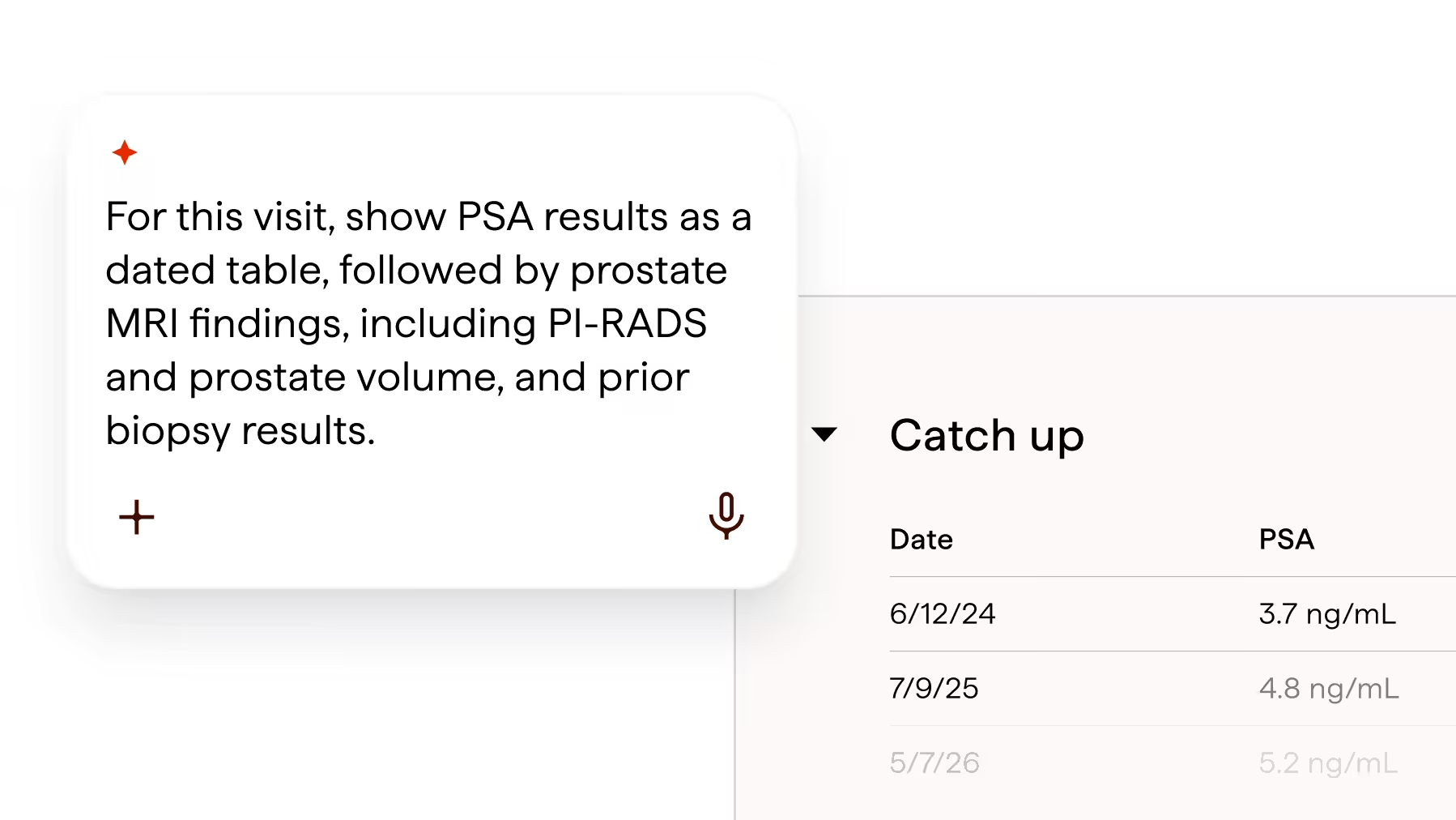
In an upcoming release, clinicians using Abridge will be able to precisely tailor their own pre-visit summary, including what information is prioritized, the timeframe considered, and how it is organized. Using Abridge Assistant, clinicians will be able to tell Abridge what they want changed about a generated summary and see those changes appear in real time. The goal is to empower clinicians with the information they need exactly how they want it, so when they enter the room they can focus on the patient in front of them.