



“Pediatrics, the Often Overlooked Specialty”: How Rady Children’s Is Using AI to Change That
“The keyboard is completely out of the mix.” Dr. Dieter Sumerauer, Associate Chief Health Information Officer at Rady Children’s Health, on clinician burnout, pediatric innovation, and why ambient AI is changing how medicine is practiced.
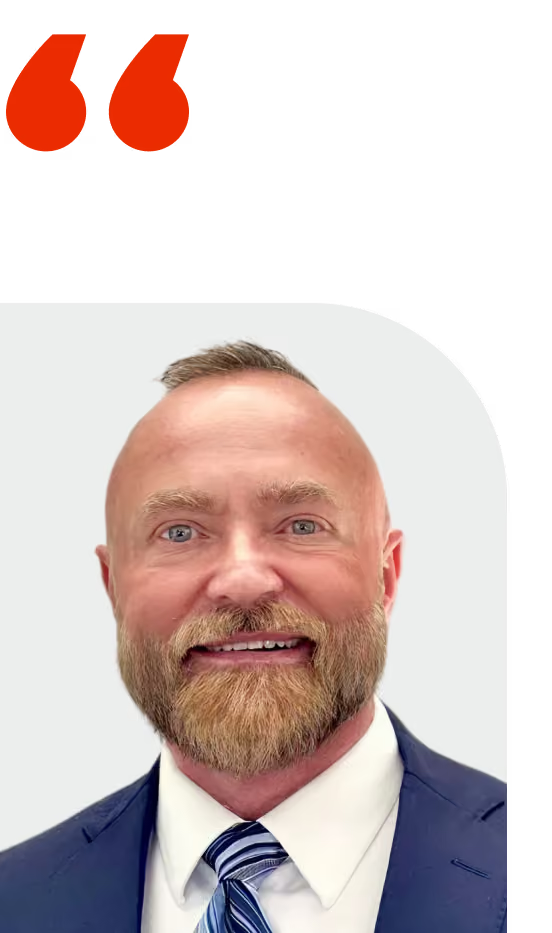
In Conversation with Dr. Dieter Sumerauer
When Dr. Dieter Sumerauer first encountered ambient AI, he was skeptical. “I was the guy with the great auto text library,” he said. “I finished my notes before I left the room. I didn’t have pajama time at home. I thought, ‘I don’t think this will help.’”
Twenty-six years into practicing medicine, Sumerauer believed he had already mastered documentation efficiency. But as the technology evolved, so did his perspective. “Since I started using Abridge, two years ago, I haven’t touched a keyboard in an exam room,” he said. “It’s been a game changer.”
For Dr. Sumerauer, that shift represents more than workflow improvement. It’s changing how clinicians connect with patients, and how pediatric care can evolve when technology gets out of the way.
You were initially skeptical of ambient AI. What changed your mind?
I was a skeptic when this first came out. I thought, “I won’t like the output.” I was the guy with the great auto text library. I finished my patient visits when I left the room. My notes were signed. I left the office when I was supposed to every day. Also, I had used remote scribes years ago, and they didn’t change my productivity or my interactions with the computer.
I still touch the mouse because I reconcile medications and allergies and review vital signs with patients and families. But the note itself is generated with Abridge. Abridge has taken that third element—the keyboard—completely out of the situation. I’m now only interacting with the patient and family. That’s been a game changer for everyone. It’s changed the way I practice, and I’ve heard that from other people as well.
How are clinicians responding to Abridge?
The responsiveness has been overwhelming. We went from 20 users to more than 130 very quickly, really over the course of four to six weeks, and that growth has happened almost entirely through word of mouth. Clinicians are hearing from their colleagues how much this changes their day-to-day work, and once they start using it, they don’t want to stop. I’ve gotten emails from physicians saying, “Thank you for bringing this to Rady Children’s Health.”
Most of what we hear is excitement, people saying, “Wow, this is great,” “This is awesome,” “It’s changing what I do.” They’re excited about how easy it is to use and the quality of the output.
What kinds of changes are you seeing in how clinicians practice?
A lot of times administrators look at technologies like this and ask, “what’s the return on investment?” How many more patients can we fit into a day? We don’t really look at it that way at Rady Children’s Health. We look at it as: how do we best support our physicians?
And it’s not just about opening appointment slots. In pediatrics, continuity matters. Families want to see their pediatrician, not just any clinician. So when physicians are able to stay in practice and expand access, that has a real impact on patients and families.
What impact are you seeing on the patient experience?
Patients are floored by the fact that the doctor is spending time with them. There used to be this perception, you’ve seen the cartoons, where the doctor’s back was to the patient because they were typing into the computer while the patient was talking.
Now you can just walk in and focus on the patient and family. What I’ve started doing is creating the note in the room with the patient and then reviewing it with them in real time. They look at it and say, “wow, that’s amazing, it really captured it.” We can correct things in real time. That’s a huge shift. It allows the patient to be part of writing their story and makes sure what we’ve documented is accurate.
How does EHR integration factor into the overall experience for clinicians?
The core piece is supporting how clinicians practice and getting them back to practicing medicine, not information technology. But the integration takes it to the next level. We didn’t think that Abridge copy/paste was going to be that big of a deal. The UX is really easy to use. But there are extra step and clicks. Integration makes it easier to bring the output into the workflow without extra work.
What has felt different about Rady’s partnership with Abridge?
The responsiveness. Listening to what’s going to make the product better for our clinicians and for our organization. That’s been one of the biggest differentiators for us. We’ve worked with a number of different solutions, and what really stands out here is the willingness to iterate with us, understand how pediatrics is different, and adapt based on how our clinicians actually practice.
We were the first alpha partner for the Cerner integration, and we were very proud to help pilot that work. But really, it’s the people who have made the difference.
How well do existing healthcare technologies support pediatric care today?
Pediatrics tends to be the forgotten specialty in medicine. People think it’s just medicine for little people—it’s not. The physiology, the anatomy, the psychology, it’s all different. You’re talking about a completely different style of medicine.
What’s interesting is that so many of the big innovations in healthcare have come out of pediatrics. But when innovation comes from the other direction, pediatrics is an afterthought. There’s no EHR in the country that’s designed for pediatrics, they’re all playing catch up.
And the reality is, it comes down to economics. Pediatrics is the lowest-paid specialty in medicine, yet we take care of our most vulnerable. From where I sit, it’s one of the most important specialties, we start everybody off in life, yet we’re the afterthought.
What opportunities does that create for innovation going forward?
If we can continue building technology that’s actually designed for pediatrics, whether that’s note templates, workflows, or models that reflect how we practice, that would be huge.
I don’t think this is unique to any one platform. It’s a broader opportunity across healthcare technology. Pediatrics has historically been underserved, so there’s a real chance to go deeper in developing tools that truly reflect how we care for our patients.
What excites you most about where this technology is headed?
I like to say we’re probably transitioning from infancy into toddlerhood with these technologies. When I started practicing medicine, I was handwriting my notes. Then I was dictating them. Now I can walk into a room and focus entirely on the patient and family while technology generates the documentation for me.
What excites me is where this goes next. I’m looking forward to a future where the information I need from a patient’s history is already synthesized and available at my fingertips, where I’m not digging through the electronic health record because the technology has already done that work. A future where I can combine that history with the current information from the patient and my clinical acumen and then have the technology augment my understanding. We have some of this technology already, and that’s certainly the direction we’re headed.
Why does this work matter to your team?
If we can further the practice of medicine and improve the lives of clinicians and patients, we’re all in for that. When you look at the impact this is having, I think people will recognize that this is a technology that’s really for them.
Learn more about Rady Children's approach in a Becker's webinar with Dr. Sumerauer: Register here