



How Abridge Assistant is Reshaping Clinical Practice: Dr. Jessica Faraci of Maine Health
Family medicine spans every stage of life, with relationships that often deepen over years of care. Each visit is part of a larger story, and a concern raised today can take on new meaning as the story progresses. That continuity is central to primary care, but keeping the full picture in view for each patient over their lifetimes is demanding. When a patient returns year after year, clinicians have to quickly reconnect with their story, piecing together what they remember and what’s buried in the chart.
Abridge Assistant brings contextual clinical reasoning to the point of care. Built by clinicians and machine learning scientists working side by side, it's trained to weigh what matters the way a clinician would: the allergy that rules out a drug, the family history that moves a screening up, the guideline exception this patient meets. It draws on the conversation, the chart, and trusted medical literature to deliver evidence-based responses without pulling you out of your workflow. Now live across more than 300 health systems, and getting sharper with every capability clinicians ask for.
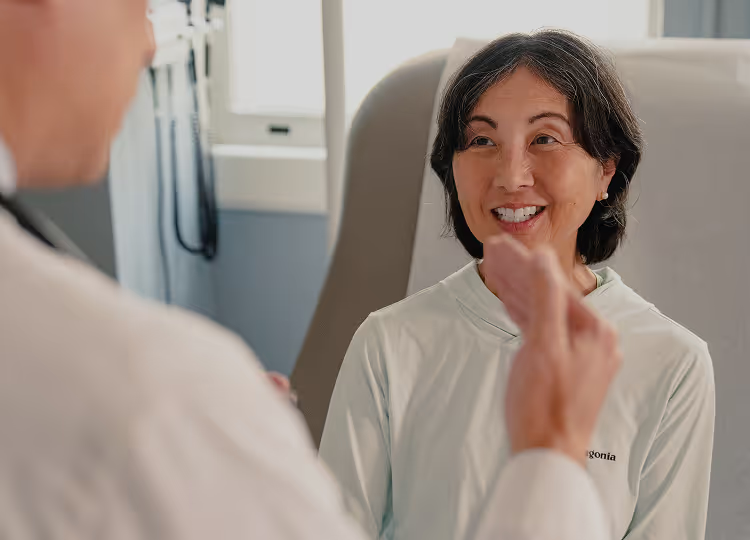
We sat down with Dr. Jessica Faraci, a family medicine physician at Maine Health and an early adopter of Abridge Assistant’s context-aware clinical intelligence for decision support. In our conversation, she shared how she's using it in her own practice, new ways she's put it to use beyond the exam room, and the difference it's made in the care she delivers.

In Conversation with Dr. Jessica Faraci
Tell us about your practice. What does a typical day look like?
I'm a family medicine doctor, so I see patients from birth through the end of life. We joke “it's womb-to-tomb.” I might see a three-year-old in one room and someone who's a hundred and two in the next. Because I'm doing something different in almost every room, it's been hard to find technology flexible enough to keep up, even though I'm an EHR super user myself.
Take us back to the first time you used Assistant for decision support. What was your initial reaction?
I was already a heavy user of another clinical AI app, and it had been a big help. But the difference with Abridge Assistant is that it's built right into the chart. I don't have to open a separate window and retype a version of the patient's history just to ask a question. It already has the labs and the findings from this visit or past ones. It even generates questions on its own, and about half the time those are exactly what I was already thinking. That's probably saved me another thirty minutes a day, on top of what the rest of Abridge already gave me back.
Why is Assistant especially valuable in a family medicine practice?
In family medicine, continuity is everything. Most of my patients I've known for years, and there's a lot I carry in my head just from knowing them, but a lot of it is also buried in the chart, further back than I could easily pull up myself. Being able to look back across the last several visits and bring that history into the current one is a real difference. It's part of why primary care works when it's done well. You're not just treating what's in front of you. You're treating it in the context of everything that came before.
Walk us through a recent example of how you used Assistant’s decision support in an actual visit.
A patient brought up a new oral cholesterol therapy she'd heard about, and I remembered seeing something about it in the news. While she was talking, I asked Abridge about it and learned it's still in a phase three trial, not something available yet. I didn't have to stop the visit, get on my computer, and go searching. I had the answer in a few seconds and could tell her honestly where things stood. That happens multiple times in a single visit for me now.
Have you discovered any new use cases since you started using Assistant?
I've used it for a lot more than clinical questions during a visit. I had to write a letter summarizing a patient's medical history, something like four years of an ongoing illness, for a form she needed. I asked for a summary of her last four years of relevant medical problems, and thirty seconds later I had a solid draft. I still went in and adjusted the wording in a couple of places, but instead of writing it from scratch, I was done in three or four minutes. I've also used it for patient handouts, when the standard version doesn't quite match what I want a specific patient to walk away with.
How has Abridge Assistant changed the way you think about your practice?
I wouldn't say it's kept me from leaving medicine, but it's part of why I'm still here. Primary care is hard right now. I know a lot of colleagues who are cutting back their hours or leaving the field entirely, and this is one of the few things that's actually given time back in the day. It means I can give patients more detailed, more accurate answers, faster than I used to, and the quality of what I'm telling them—not just the speed—has genuinely improved. It has dramatically changed the care I'm able to provide.
If I could tell other clinicians one thing, it's this: Don't be afraid to be an early adopter. This is where medicine is headed, and I think it's quickly becoming the standard of care, not the exception.
This interview was edited for length and clarity.
Want to hear from more clinicians like Jessica? Check out the rest of the series on our newsfeed here. And if you’re curious how Abridge Assistant could fit into your workflow, head to the Assistant page on our website to learn more.