




From Skeptics to Converts: How Adventist Health Built Clinician Trust in AI
A conversation with Dr. Salman Naqvi, Medical Director of Informatics at Adventist Health
When Adventist Health set out to find an ambient AI solution for its clinicians, leadership knew the technology decision was only half the challenge. The other half was people. Dr. Salman Naqvi, one of three Medical Directors of Informatics at Adventist Health, has been at the center of that journey, from evaluating vendors across a multi-state health system to navigating the very human process of earning clinician trust at scale.
Spanning California, Oregon, and Hawaii with 430 outpatient clinics and 27 hospitals, Adventist Health needed a solution that could grow with them, support diverse patient populations in multiple languages, and actually stick with the clinicians using it every day.
In this conversation, Dr. Naqvi shares what he learned about clinician skepticism, change management, and what it really takes to turn reluctant adopters into advocates.
About Adventist Health
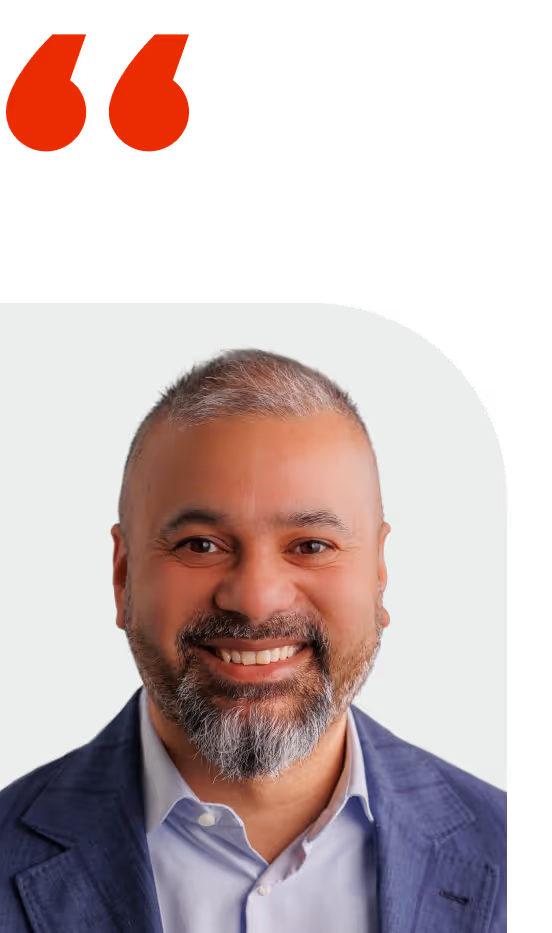
In Conversation with Dr. Salman Naqvi
What led Adventist Health to start looking at ambient AI?
Our clinicians were under real pressure. Documentation burden had become one of the biggest sources of frustration across our medical group, and we knew we needed to do something meaningful about it. We have roughly 2,000 employed providers, and we wanted to find a solution we could actually extend to all of them, not just a select few.
A few things stood out when we evaluated Abridge. One was the multi-language capabilities. We're all over California, Oregon, and Hawaii. Punjabi and Tagalog are spoken in Central California, Armenian and Russian in Southern California, and Spanish across the board.
You started without a traditional pilot. What was behind that decision?
Honestly, we'd done our due diligence. We talked to reference sites, and we understood what we were getting into. We realized that pilots don't necessarily reduce the work. If you're going to put in the effort, you might as well commit. So we started with about a dozen users in August of last year, then set up a nomination process in September. Clinicians could apply on their own behalf, or recommend a colleague and share why they'd benefit from the technology.
We tried to lower every barrier to entry. No lengthy training requirements, no complicated criteria. Just: here's the technology, give it a try. What we found was that people came to it from very different starting points. Some had never had any documentation support before, others had existing workflows they'd spent years perfecting. That meant change management was going to be just as important as the technology itself.
How did you manage that change, especially for clinicians who were skeptical?
Everyone starts with a different kind of skepticism, and you have to understand where it's coming from. For some clinicians, it's about style. They've spent decades perfecting how they write a note, and any deviation from that feels like a step backward. For others, it's about precision: does the note reflect how they think, not just what was said. Those are legitimate questions, and my job isn't to dismiss them. It's to figure out whether it's a personal preference or a genuine feature need, and move forward from there.
What helped most was giving people a channel to be heard. Abridge's support infrastructure made it easier for end users to surface issues directly, without it having to come through me every time. And as those issues got addressed, something shifted. The same clinicians who came to me with doubts started going to their colleagues instead. Not because we pushed them to, but because they'd experienced the difference themselves. That word-of-mouth effect ended up being one of our most powerful adoption tools.
Were there any specialties that surprised you in terms of adoption?
Inpatient psychiatry was the biggest surprise. Our planning had been focused on the ambulatory space, so when one of our inpatient psych physicians came to us and said she wanted to try it, my honest reaction was uncertainty. She proved me wrong entirely. She said it worked perfectly for her workflow. That kind of discovery, finding use cases we hadn't anticipated, was one of the more rewarding parts of this process.
It also reinforced something important: the right approach is to let clinicians lead. When you remove the barriers and give people the freedom to explore, they often find value in places you wouldn't have thought to look.
Tell us about the Cerner integration. What changed for your clinicians when that went live?
How has the platform evolved since you started, and what does that mean for your team?
When we went live in August of last year, the focus was on note quality: could it improve, could it adapt to individual preferences? That bar has been raised significantly. Now we're talking about HCC reconciliation showing up directly in the recording workflow, post-recording AI edits, clinical decision support. We're not even a full year in, and the range of what the platform can do has expanded substantially.
What makes that feel manageable is the pace at which Abridge operates. In traditional vendor relationships, features can take quarters to materialize. Here, we get on a call with the team and they're ready to move the next day. That responsiveness, being never more than a call away from getting something resolved, is something our clinicians feel directly.
What do you value most about this partnership?
Three things: nimble, speedy, and efficient. You don't have to navigate through multiple teams to get something done. The support infrastructure means issues get surfaced and resolved quickly, whether it's coming from an end user, or from us as an organization.
And the speed of feature development is unlike anything I've experienced in a traditional vendor relationship. Those aren't small things when you're trying to maintain momentum across a system this size.
What are you looking forward to as you head into the second half of the year?
In the near term, we're focused on process integrity, making sure that every recording has a consent, and that if someone didn't consent, nothing gets reported. That kind of end-to-end reliability matters enormously at scale.
But the bigger picture is what this has taught us about AI more broadly. Abridge has become stable enough that we don't need to spend a lot of time scrutinizing what's happening in the ambient listening space. That frees us up to think about where else AI can help: administrative burden, clinical workflows outside the patient encounter, grant writing, calendar management. Things clinicians still wrestle with every day.
And more fundamentally, it's given us a clearer view of what the clinician of the future looks like. If you can take the documentation burden off their plate and give them a platform they can trust, you can give them back the time and mental space to focus on patient care. That's the goal. That's always been the goal.
This interview was edited for length and clarity.